
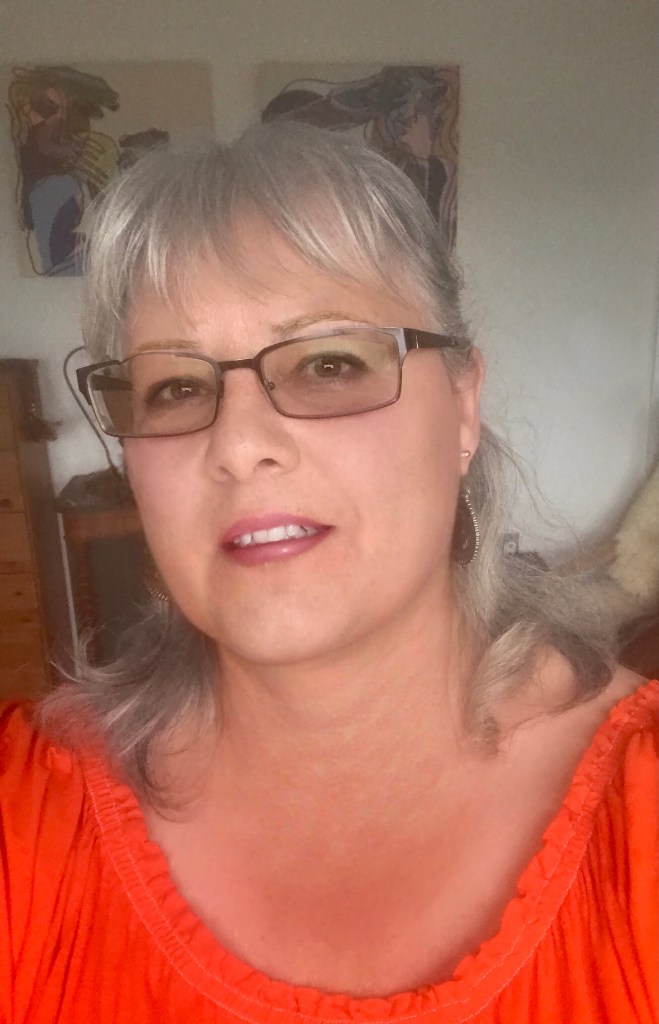
Welcome! I’m Ananda Amenet Reid.
A finished work of art doesn’t betray the full journey it took to make it.
It doesn’t show the rubbings out, the choices that were abandoned, the technique that was corrected.
It doesn’t convey the struggle or hint at the time taken.
A finished artwork may be judged as competent and serene.
Or maybe as ‘not very good’.
The moment the artist said to themselves, “Stop now”, the work of art was no longer an exercise in creativity for the artist and an invisible umbilical cord was severed.
Now, it belongs in the realm of the viewer.
And whether the artist chooses to hide it away or display it, it’s a single point in time.
It’s an arrival, the journey itself never to be fully understood by anyone other than the one who made it.
If displayed, it is subject to opinion and the artist’s heart and delicate ego cannot but fail to have made an investment.
Sadly, some viewers will never see the surrender, the love, the investment.
They will objectively assess the work of art based on their own filter, educated or uneducated, using standards that are arbitrarily agreed by an in-the-box society.
These views are not for the artist.
For artists, such views are worthless.
We are the ones who are in relationship with that work of art during the making of it.
If we put our heart into it, then it is our heart brought out and displayed.
No matter how strange, different, ‘good’ or ‘bad’ our art is, there will always be someone to whom it sings it’s siren song, someone who is its divine right audience.
Artists, don’t be afraid of putting your art out there, even if it feels like letting go of your children.
If it feels like that, it’s because we are.
Identity
Don’t we get to work identity out for ourselves by now?
And what’s this about others being offended about our choices, even when they come from our hearts and express our truth?
We are more than a body. We are more than an expression of our society or culture.
We are the pearl inside, not just the outer shell that others see.
My paintings are about judgement and who is the judge.
The paintings represent the ancestor, the elder, to whom we individually feel a connection, who may be a connection of the soul rather than blood.
As an adopted person, I have grown up with a different perspective on who are my ancestors and what is my bloodline. Knowing nothing of my genetic background, I have found my family in my identity as a spiritual being, an energy being. I carry recollections of past lives lived in various cultures across time, so who am I? My answer is, all of it.
My art is asking us to revisit the idea of cultural appropriation, who owns identity, who is insulted and why.
I am currently working on two new bodies of work:
‘Divine Feminine’ is a thought-provoking collection of paintings that delves into the sacred and empowering nature of intimacy, sensuality and sexuality in women. Through these artworks, I am celebrating the beauty, healing, and connection found in expressions of womanhood, focusing on the experiences of women who have embraced their power, particularly women who love other women and those who have embraced their inner crone. Each painting attempts to capture the essence of intimacy and sexuality as natural, sacred, radiant and empowered, inviting viewers to reflect on the profound depth and strength of feminine spirit.
The ‘Spirit Animals’ series features paintings that are channeled from the source of archetypal animal consciousness. Each painting embodies the wisdom, symbols, codes and keys held by a particular animal consciousness, serving as a conduit for the energies that the animal represents for Earth and humanity. These works of art convey ancient lore and spiritual teachings through the visual representation of each spirit animal, offering viewers a deeper connection to the natural world and the energies that surround us. Through these paintings, we are invited to explore the profound wisdom and guidance that spirit animals can offer us on our personal journey of self-discovery and spiritual growth.
environmentally friendly art
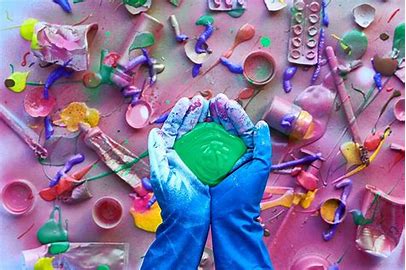
link: https://acrylgiessen.com/en/is-acrylic-paint-toxic/
I searched for an alternative to acrylic paint because acrylics are essentially plastic. Acrylic paint is not biodegradable or sustainable and not good for the environment. It cannot be safely washed down the drain because it introduces micro-plastics into the waterways and eventually the sea. If disposed in landfill, it will never degrade.
When searching for an alternative, I discovered Brusho crystalline powders and really enjoy working with them. They are transparent, highly pigmented watercolour inks that come in the form of a dry, crystalline powder. The colours are vibrant, which is very me, and they have a responsive and playful relationship with water, which I love. They are impossible to control, one must go with the flow and working with them is all about surrendering.
The resulting paintings are expressive and unpredictable, often with a kind of vulnerable delicacy about them.
Crystalline powder paintings are archival quality paints.
The powders contain no animal ingredients or by-products, they are non-toxic and not tested on animals.
That said, when on canvas rather than paper, Brusho pigments sometimes need to be fixed to make them suitable for display in your home. This means I may use fixative on my canvas Brusho paintings. When the canvas is stable, I will give my customer the option of leaving it unfixed which means it’s delicate and vulnerable, and I have found some of my collectors prefer it that way. As far as I know, there’s currently no suitable environmentally sustainable fixing product available, but I’m limiting my impact. If I find a natural fixative, I’ll be pleased to update my practices.
I also love painting with gouache, which is an opaque watercolour paint. Gouache gives me the strong, bright colours I love and the ability to paint with detail and precision. Gouache consists of natural pigments and non-toxic binders, making it eco-friendly. Gouache and Brusho are beautifully compatible.
 ananda amenet reid: art